Friday, June 22, 2007

Football Hooliganism

Football, used to be a good, entertaining and fun. Football has been changed a lot over the last decade because of the Hooligans in the football game. Hooligans of the football game are known as firms, this is a group of friends who go through thick and thin for the sake of their favorite team. They go to mental lengths this making the club in debt by fines and being banned from competitions.

The police are in a concurrent war with the thugs of the British game, this making a lot of problems in and out of the football arena. The police just can't crack down on the thugs because of the amount of fans all from different clubs fighting for honor and for their team. Many gangs/firms are very well known and have a very large Reputation.

The football clubs attempt to pass on messages to the fans warning them about the consequences they are bringing amongst themselves and among the football club.

There is no real 'Dangerous Firms' in the UK which is superb as in comparison with other countries it is good here, take the Italians for example against Manchester United Football Club Plc. They tore down their own club fences and ripped out chairs to enable a good position to attack innocent fans! Even the police didn't help at all in fact they were the real 'hooligans' in that game! Which took the world by surprise but, the Italians have a very bad reputation against the main amount of the world.

This hooliganism amongst Britain must stop! They are running riots through towns ruining the surroundings and putting innocent people in immediate danger!

Thanks for reading this article on the Hooliganism in the British Empire of football!

Wednesday, June 20, 2007

Jamison Set To Carry Wizards Alone With Butler And Arenas Injured

The entire load of upsetting the Cleveland Cavaliers in the first round of the playoffs now rests solely on Antawn Jamison.

The reason behind is out of the Big Three in Washington Wizards, two are injured and these days Jamison is the key player for the team.

Forward Jarvis Hayes said that Jamison is the leading scorer for the Wizards now and he would have to be a lot more aggressive in the offense. The other players' main job to now is to make things as easy as possible for Jamison on the court. Hayes expects things to get difficult as teams would now be targeting Jamison more than before.

Every player on the Wizards' team has had his role changed ever since Gilbert Arenas injured his knee and Caron Butler his hand. However, it appears that Jamison has been affected the most by the injuries. He does not have the luxury to bide for time and find open spaces as defenders of opposing team are concentrating elsewhere. No longer can Jamison have a night off as his two team mates are not there to fill in for him.

Coach Eddie Jordan said with Butler and Arenas out with injuries, Jamison would have to take on added responsibility of being the passer, the setup player and also the scorer.

Jamison was in a similar situation for several season when he was with the Golden State Warriors. As a matter of fact, he managed to score 51 points in back to back games way back in 2000.

He joined the Wizards in 2004 and has primarily played the wise veteran to young Arenas' impulsiveness. This statistics have been quite consistent in the last few years. He usually scores 20 points and 8 rebounds in each game. In the regular season this year, Jamison has averaged 19.4 points and 8 rebounds.

Jamison knows that he cannot carry the Wizards alone. He said that it was too much pressure and a player could get into trouble trying to do it because it was impossible to the things that Arenas and Butler do all by himself.

For the Game 1 against the Cavaliers, even though Jamison knows he cannot alone defeat them, his team will look up to him for more points, rebounds and on-court leadership.

Thursday, June 14, 2007

Baseball Tryout Drills

Every coach needs a good selection of baseball tryout drills that allow each prospect to demonstrate their abilities both on the field and at bat. This will allow the coaches to fully evaluate each prospect's skill set to see if it indeed is strong enough for their team. It also allows coaches to build a team that will be able to work together, playing off each other's strengths and covering up for the weaknesses.

I like to start each of my baseball tryouts with arguable the most fun part of the game: hitting. Since hitting can make or break a team, I run a number of hitting drills at each of my tryouts. The first of the baseball tryout drills to see which are the Babe Ruths and which are merely mediocre is this one which rewards players with the ability to control their hitting.

Throw pitches at players one at a time. As the pitch sails towards the player call out what type of hit you'd like them to perform: line drive, pop fly, foul ball, grounder. Make sure to tailor the pitches to help players make the right hit. Try to remember which players have already hit what type of pitches so you can see every player attempt to perform every type of hit.

The In's and Out's of Fielding

To maximize productivity, while half the players hit, employ to other half to demonstrate their throwing and catching skills, using these baseball tryout. I like run a different set of drills for infielders and outfielders, since each position requires more finely tuned skills in different aspects of throwing and catching.

For my outfielders, a classic long toss drill helps determine which players will be able to make crucial long throws from deep center and which haven't quite built up the necessary arm strength to be protecting the far corners of the field. Another great outfielder drill has players partnered up and throwing each other a variety of pop-ups, grounders and line drives. This exercise will gauge players' interactions with others as well as their fielding skills in a medium-pressure situation.

For infielders, I like this drill that rewards quick thinking infielders. Stand at the place with a bat and a bucket of ball. Start batting towards the players one at a time, making sure to vary your hits and the players fielding the ball. While the ball is being batted, call out a situation for the players to follow. For example, hit a line drive towards shortstop while yelling "runner on 1st, two outs" to see how the player would react in that situation. Run this drill for at least 5 minutes, giving each player a variety of scenarios before switching the infielders and outfielders.

The Importance of Scrimmage

Baseball tryout drills can only go so far. To truly gage a player's performance on field, the coach must witness them in action during a game scenario. I always end each baseball tryout with a short scrimmage allowing each players at least once chance in infield, outfield and at bat.

For the batting team, always watch players both while they are at bat and how they act when they are idle. Think twice before selecting players who goof off constantly or intentionally distract their fellow prospects, since they may become a handful and difficult to control at practices and during games.

Saturday, June 2, 2007

How to Cut Your Warm Up Times in Half in Youth Footbball

Need more practice time? Think about areas of your football practice that you can shave time off of.

"Static stretching" are traditional stretching movements like toe touchers, windmills, hurdlers stretch etc. For the last 40+ years these type of movements have been used by youth football players to warm and loosen up.

Today most experts in the field actually believe these type of movements reduce power output. They suggest players should prepare for football practice or games by doing a "dynamic" warm up that moves from basic, low intensity movements to faster, more explosive movements as the muscles warm and loosen up. They suggest movements that simulate what the players will go through during football practice or games.
For most kids in the 8-12 age group, muscle development has not been extreme and most of the players have a good deal of natural flexibility. I've seen youth football teams age 6-8 using 15-20 minutes of valuable practice time to do various stretching movements, when players this age can usually bend their feet up around their heads, a waste of time.

We start with players in stances and doing very low intensity high-knees movements of 10 yards or so, we move to "butt kicks" and then angle form tackling, all at slow to medium level speeds. We accomplish some skill building, stance, cadence, starts, and form movement while getting blood flow to the muscles and getting our "warm up" accomplished in 5-10 minutes or less. Now the kids are warm enough to safely go into individual skill development or team work like running our football plays out 20 yards at full speed.

In 15 years of coaching youth football, my teams have NEVER had a player "pull a muscle" while practicing or playing a game. Coaching Youth Football well is all about priorities, don't waste valuable practice time on something most experts feel is wasted time. Use your time to teach blocking and tackling and getting great at your football plays.

For more free youth football coaching tips or to sign up for Dave's free youth football coaching tips newsletter please go to:

Football Plays

Thursday, May 31, 2007

Miami Dolphins History- Are you a True Fin Fan?

Present day Miami Dolphins fans – come on, you know you are out there – may know quite a bit about their favorite NFL team. But, this knowledge may be limited to recent years, such as the Dolphin's record during the 2006 season or which player they took as their number one draft pick. How much do you know about the Dolphin's history? Take our quiz to find out.


1. The first owner of the Miami Dolphins is widely known to be Joseph Robbie. But, he originally bought the franchise with a famous actor serving as his partner. Who was the actor?


a. Marlon Brando


b. Burt Reynolds


c. Danny Thomas


d. Haley Joel Osment


2. When the Dolphins began to play in 1966, what served as their original home stadium?


a. The Orange Bowl


b. The Raymond James Stadium


c. Tropicana Field


d. Lambeau Field


3. What was the Dolphin's record in their first season?


a. 3-11


b. 4-10


c. 14-0


d. They tied every game


4. When Don Shula became head coach of the Miami Dolphins, who did he replace?


a. Tom Landry


b. George Wilson


c. Jimmy Johnson


d. Joe Torre


5. When the Dolphins hired Don Shula as the coach, what team charged Miami with tampering?


a. The Indianapolis Colts


b. The Baltimore Colts


c. The New York Jets


d. The Jacksonville Jaguars


6. The early 1970's were the height of the Dolphin's success. During this time, they became the first NFL team to do what?


a. Win Three Consecutive Super Bowls


b. Make it to Three Consecutive Super Bowls


c. Win back to back Super Bowls


d. Win one Super Bowl


7. The 1971 AFC Divisional Playoff game between the Dolphins and the Kansas City Chiefs set a record as what?


a. The NFL game with the most field goals


b. The most lopsided NFL game


c. The longest NFL game


d. The day the most hot dogs were consumed


8. What was the nickname of the 1972 Dolphin's defense?


a. The No-Name Defense


b. The Steel Curtain


c. The Wall


d. The Big Unit


9. During the 1973 season, the Miami Dolphins repeated as Super Bowl champions by beating what team?


a. The Green Bay Packers


b. The Chicago Bears


c. The Minnesota Vikings


d. The Carolina Panthers


10. The AFC Divisional Playoff game played on December 21, 1974 between the Dolphins and the Oakland Raiders went down in football folklore as what?


a. The Sea of Hands Game


b. The Ice Bowl


c. The Drive


d. It didn't have a name; this is a trick question


Answers: 1. c. Danny Thomas; 2. a. The Orange Bowl; 3. a. 3-11; 4. b. George Wilson; 5. b. The Baltimore Colts; 6. b. Make it to Three Consecutive Super Bowls; 7. c. The longest NFL game; 8. a. The No-Name Defense; 9. c. The Minnesota Vikings; 10. a. The Sea of Hands Game.


See how you did:


9-10 correct: You are a true Miami fan. You can swim with the Dolphins anytime. Two fins up!


6-8 correct: You might not have received a perfect score, but you still know quite a bit about the only team to ever have a perfect season.


3-5 correct: You didn't do great, but you didn't do horrible. One fin up, but not two.


Less than three: Maybe you are better of as a Jacksonville Jaguars or a Tampa Bay Buccaneers fan.

Sunday, May 6, 2007

Pedro Gomez Finally Has Someone Else to Harass

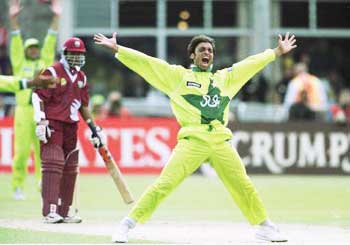
You knew it was going to happen eventually. It was too good to be true, with all the pleasantries and mid-game tea times and week-long Test matches. But now, cricket has its Jeremy Giambi.

Ladies and gentlment, meet Shoaib Akhtar. He’s a cricket player from Pakistan, and he holds the record for the fastest ball thrown in a Test match. That ball registered at 161.4 km/h on the radar gun. (He’s also hit 366 wickets in his career, which sounds pretty good, too.)

Alas, according to the BBC, it was too good to be true. This is what Akhtar had to say in his defense:
"I have always played the game fair and I give 100% and do not feel that I need to take drugs to help my bowling."
I'm looking forward to next week's edition of "The Sports Reporters." Mike Lupica probably can’t wait to blame this one on Barry Bonds.